Snapchat returns to service in Syria: Details of lifting the digital ban
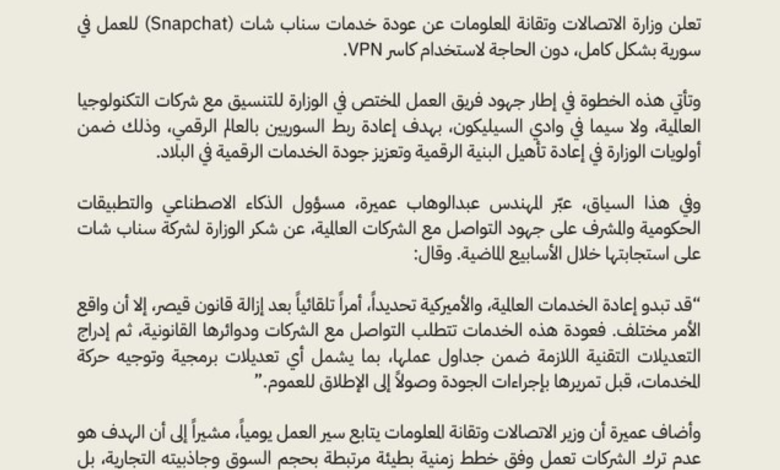
In a significant step towards breaking the digital isolation, the Syrian Ministry of Communications and Information Technology announced the return of Snapchat services to full and normal operation in Syria, without the need to use VPNs that Syrians have relied on for years.
Government efforts to connect Syria to the digital world
This significant step comes as part of intensive efforts by the ministry's specialized team to coordinate directly with global technology companies, particularly those based in Silicon Valley. These initiatives aim to reconnect Syrian citizens to the global digital ecosystem, a key priority for the ministry in rehabilitating the country's digital infrastructure and enhancing the quality of services provided, which have been severely impacted over the past decade.
Background of the ban and its impact on users
For years, Syria's technology sector has suffered from sanctions and technological embargoes imposed by major American and international companies, forcing millions of users to resort to alternative solutions such as VPNs. These solutions often result in slower internet speeds, drained phone batteries, and security risks related to data privacy. The return of a platform the size of Snapchat is a positive indicator that these restrictions are beginning to ease and that technical exceptions are being made to allow civilians access to personal communication services.
Behind the scenes of the comeback: A complex legal and technical process
In this context, Engineer Abdulwahab Amira, Head of Artificial Intelligence and Government Applications and Supervisor of Communications with Global Companies, explained that this was not simply an automatic procedure. He expressed the Ministry's gratitude to Snapchat for its effective response over the past few weeks.
Amira explained the technical complexities: “The restoration of global services, and American services in particular, may seem automatic after talk of easing restrictions or removing obstacles of the Caesar Act with regard to technology, but the reality is quite different. The return of these services requires close communication with companies and their legal departments to ensure compliance, then including the necessary technical modifications in their work schedules, including software modifications and server routing, before passing them through quality procedures to the point of public release.”.
Ministry strategy: Speed and priority
Amira added that the Minister of Communications and Information Technology is monitoring the progress of the work on a daily basis, noting that the current strategy aims not to leave companies working according to slow time plans that may usually be linked to the size of the Syrian market and its currently limited commercial appeal, but rather to work on accelerating the activation steps in line with the actual needs of users in Syria.
The ministry stressed that the focus is currently on the most used and popular local platforms, in addition to global platforms that provide infrastructure services such as hosting and information security, as the return of these services means making thousands of currently blocked sites directly available, which will have a positive impact on the business sector, startups and Syrian developers.
The role of Syrian talents abroad
It is worth noting that the Ministry of Communications is working to accelerate the return of global platforms in cooperation with technology institutions such as "SYNC", and with the support of a large number of Syrians working in major technology companies around the world, who play a pivotal role in bridging the gap and clarifying the picture for global companies about the importance of providing these services to Syrian society.