Mertz warns of a world ruled by force and the unraveling of US-European relations
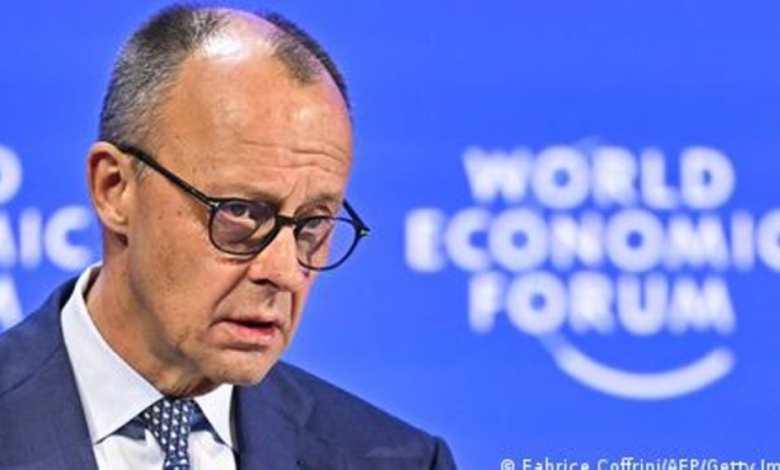
German Chancellor Friedrich Merz issued stark warnings during his participation in the World Economic Forum in Davos, asserting that a world governed solely by force is "a very dangerous place." These remarks come at a critical juncture, as the global order undergoes profound transformations, most notably the ongoing Russian-Ukrainian war , the rising geopolitical influence of China, and fundamental shifts in the security and political doctrine of the United States.
Lessons from history and the dangers of sliding into the abyss
In his widely circulated speech, Merz invoked painful lessons from history, pointing out that relying on the logic of brute force threatens not only small and medium-sized states, but also major powers. "In the 20th century, my country, Germany, followed this path to its bitter end, dragging the world with it into a dark abyss," Merz said, in a clear reference to the horrors of World War II and the devastation wrought by policies based on expansion and military dominance.
This warning takes on particular significance within the historical context of the modern world order, established after 1945 on the principles of international law and international institutions to ensure that the tragedies of the past are not repeated. Observers believe that a return to power politics threatens to undermine decades of relative stability and international cooperation, leaving the world facing unpredictable scenarios.
The transatlantic alliance is fracturing
In a related development, and reflecting growing European concern, German Vice Chancellor Lars Klingbeil warned that historic relations with the United States could be "on the verge of unraveling." Klingbeil, who also serves as finance minister, indicated during a speech at the German Institute for Economic Research (DIW) in Berlin that Europe is going through a critical period in which existential questions are being raised about its core principles and traditional alliances.
These concerns arise amid geopolitical tensions fueled by President Donald Trump's , which prioritize purely American national interests, thus putting the European-American partnership to a real test. Klingbeil emphasized that "the transatlantic alliance is undergoing a far deeper transformation than we have been willing to acknowledge until now," requiring the continent to reassess its defense and economic strategies.
The repercussions of global transformations on Europe
The German warnings reflect widespread European concern about the erosion of the rules-based international order. With the rise of new powers and the decline of the traditional American role as guarantor of European security, EU member states are finding themselves compelled to seek greater strategic autonomy. This shift has implications not only for security but also for the economy and trade, as Europe faces challenges in safeguarding its interests in a world increasingly characterized by competing blocs and economic protectionism.