Blue Yamama Opera: The first Saudi opera to shine in Cairo
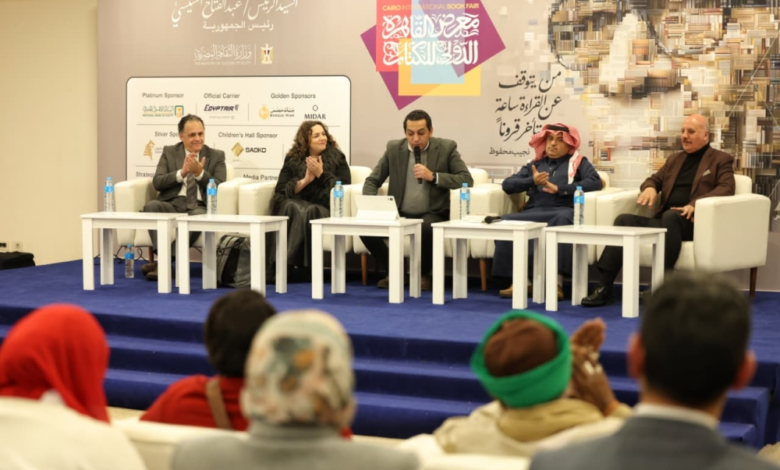
The main hall of Cairo International Book Fair a prominent cultural event: a special seminar entitled “Zarqa’ al-Yamama: The First Saudi Opera.” This seminar, part of the “Intellectual Encounter” series, highlighted a pioneering artistic experience that blends the depth of Arab heritage with the grandeur of international opera. It featured a distinguished panel of artists, including soprano Dina Iskandar, poet and playwright Saleh Zamanan, director and critic Dr. Medhat El-Kashef, and conductor Nayer Nagy, and was moderated by journalist Mohamed Fadel El-Qabbani.
An Arab legend with a global vision
The opera is based on the story of Zarqa al-Yamama, an iconic figure in pre-Islamic Arabian folklore, known for her sharp eyesight and ability to see approaching invaders from afar. Her foresight led her to warn her tribe, Jadis, of impending invaders, but they disbelieved her and met their inevitable fate. This story is an integral part of Arabian mythology, rich in tragedy and wisdom.
In this context, the transformation of this legend into an operatic work is of paramount importance; it represents a qualitative leap in the Saudi cultural landscape, aligning with the recent artistic movement in the Kingdom to enhance its presence on the international cultural map. The work not only retells history but also reshapes it in a universal musical language understood by both East and West, thus opening new horizons for Saudi soft power.
Poetry and music: challenges of establishment
During the symposium, the text's author, Saleh Zamanan, explained that writing "Zarqa' al-Yamama" relied heavily on poetry, considering it the Arabs' record and the vessel that preserves their history. He pointed out that the greatest challenge was adapting the poetic Arabic language to fit the strict operatic forms without losing its identity.
Zaman added that the work went through complex stages, with the original text running for three hours before being shortened and the characters merged to meet the technical requirements of the opera, which cannot accommodate more than seven main voices. He also noted the collaboration with the Swiss-Italian director Daniele Vinzi Pasca, where their visions converged between the author's inclination to highlight the tragedy of war and genocide and the director's focus on messages of peace, resulting in a complete work of art.
International dimensions and massive production
For his part, Maestro Nayer Nagy confirmed that preparing for this monumental work required two years of continuous effort and necessitated intensive training for the foreign singers in Arabic pronunciation to ensure flawless performances. He noted that the opera represents a complete production with world-class standards, qualifying it for performance in major opera houses worldwide, thus reflecting the significant cultural investment in this project.
In a related context, soprano Dina Iskandar spoke about her experience performing the lead role, describing opera singing in Arabic as a great artistic challenge that allowed her to explore new vocal and expressive spaces, which helped in embodying the historical pain of the character Zarqa al-Yamama.
The symposium concluded with an artistic segment in which Dina Iskandar performed an opera piece accompanied by Maestro Nayer Nagy, giving the audience a vivid glimpse of this cultural achievement, which is an artistic document that immortalizes Arab heritage in a modern spirit.