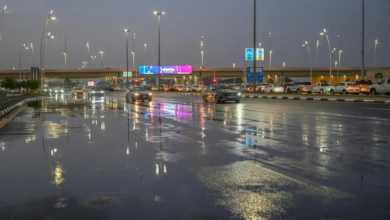
Saudi Arabia weather: Rafha records two degrees below zero and dust warnings issued

Northern regions of Saudi Arabia experienced a sharp drop in temperatures, with Rafha recording the lowest temperature of the day on Thursday at -2 degrees Celsius, a clear indication of the deepening cold air mass currently affecting the Kingdom. This cold wave has extended to several cities, with temperatures reaching near zero degrees Celsius in both Hafr al-Batin and Arar, while Sakaka and Hail recorded 1 degree Celsius, and Tarif reached 2 degrees Celsius.
Temperature details in the central and eastern regions
The cold wave wasn't limited to the northern regions; its effects extended to the central and eastern areas as well. The capital, Riyadh, along with Buraidah and Dawadmi, recorded a low of 4 degrees Celsius, while the minimum temperature in Al-Ahsa Governorate reached 5 degrees Celsius. This drop is part of the typical winter weather patterns in the Kingdom, as the country is usually affected by Siberian high-pressure systems that contribute to record low temperatures, especially in open and desert areas.
Weather phenomena and reduced visibility
In a related context, the National Center for Meteorology explained in its weather report that weather maps indicate active surface winds stirring up dust and sand. This activity is expected to reduce horizontal visibility across wide areas, including the regions of Makkah, Madinah, and Tabuk, with its effects extending to the western parts of the Northern Borders, Al-Jawf, Hail, and Riyadh, reaching as far as parts of Najran and the Eastern Province. The report also forecasts partly cloudy to cloudy skies, with a chance of light rain that may refresh the atmosphere in parts of northern Saudi Arabia.
Sea conditions and maritime navigation
Regarding sea conditions, a vital factor for fishermen and maritime traffic, the report indicated rough seas in the Red Sea and the Arabian Gulf. In the Red Sea, northeasterly to southeasterly winds reached speeds of up to 55 km/h towards the Bab el-Mandeb Strait, causing waves to reach heights of up to 2.5 meters and creating choppy sea conditions in those areas. In the Arabian Gulf, northwesterly winds reached speeds of up to 52 km/h, with wave heights exceeding 2.5 meters in the central and southern parts.
The importance of weather warnings
These reports are of paramount importance in guiding citizens and residents to take precautions, whether while driving on highways where visibility may be reduced due to dust, or when planning marine and land-based activities. The relevant authorities consistently urge the public to stay updated on weather conditions to ensure safety and avoid direct exposure to severe cold waves without taking necessary precautions.