Wadi Hanifa: The cradle of the first Saudi state and its historical capital
Introduction: Where history meets nature
Wadi Hanifa, nestled in the heart of Najd, is not merely a prominent geographical landmark, but a living chapter in the history of Saudi Arabia. On its banks, the founding chapters of the first Saudi state were written, and it was here that Diriyah, the historic capital that illuminated the Arabian Peninsula, arose. This valley tells the story of the relationship between humankind and the land, and how a unique natural environment can become the cradle of a great civilization and state.
Historical background: From Wadi Al-Ardh to Wadi Hanifa
Before its name became associated with the Saudi state, the valley was known in ancient times as Wadi al-Ardh. Thanks to its strategic location cutting through the Najd plateau, the valley formed a vital passage for trade and pilgrimage caravans, and a point of attraction for human settlement for thousands of years. It acquired its current name from the Bani Hanifa tribe, who settled there and practiced agriculture, benefiting from its fertile soil and abundant groundwater and surface water, fed by several tributaries such as Wadi al-Bathaa, Wadi Laban, and Wadi Namar. These natural resources paved the way for the valley to later become a cradle of an influential political entity.
The founding of Diriyah: the nucleus of the state on the banks of the valley
In 850 AH (1446 CE), the banks of Wadi Hanifa witnessed a pivotal event: Prince Mani' ibn Rabi'ah al-Muraydi founded the city of Diriyah. It was not merely a new city, but the nucleus that would grow into an influential political and economic center in the region. The choice of this location was not arbitrary; it was based on the strategic advantages offered by the valley, including natural protection, a constant water source, and fertile agricultural land, which ensured the fledgling city's survival and prosperity.
Capital of the first Saudi state and beacon of monotheism
The valley reached its historical zenith on February 22, 1727 (mid-1139 AH), when Imam Muhammad bin Saud established Diriyah as the capital of his state, proclaiming the First Saudi State. From this valley, the unification of vast swathes of the Arabian Peninsula under one banner began. Thanks to its location on Wadi Hanifa, Diriyah became a beacon of knowledge and reform, a center of governance, and a major turning point in the history of the entire region, establishing a stable political entity that laid the foundations for security and development.
Contemporary Significance: From the Cradle of History to the Heart of Riyadh
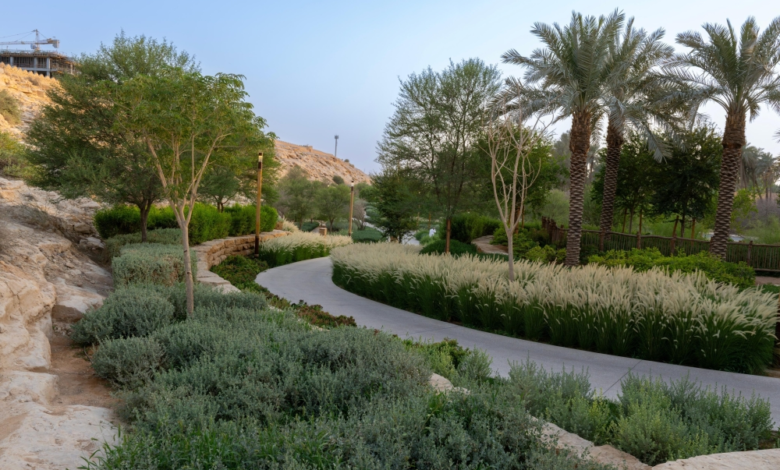
Today, Wadi Hanifa has not lost its importance; rather, it has transformed to play a new and vital role. After decades of environmental degradation, the valley underwent one of the largest environmental rehabilitation projects in the region, becoming a vast natural park stretching over 120 kilometers—a green lung for the capital city of Riyadh. Today, the valley is a tourist and recreational destination for residents and visitors alike, combining natural beauty with the richness of history, and standing as a living testament to the story of a nation that began on its banks and continued to grow and flourish.