End of Uranus' retrograde motion in 2026: Jeddah astronomical details
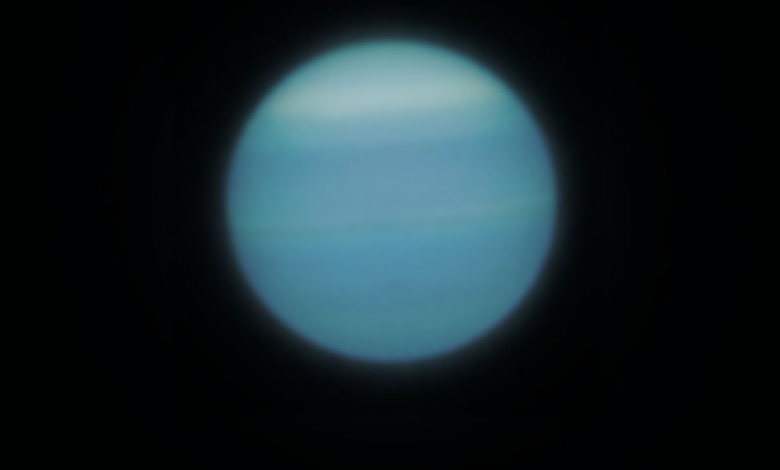
The Jeddah Astronomical Society announced a significant astronomical event occurring in the heavens today, Wednesday, February 4, 2026, as Uranus, the seventh planet from the Sun, reaches the end of its apparent retrograde motion. This event marks a turning point in the planet's trajectory as seen from Earth, as it resumes its normal eastward movement among the stars, ending a period of several months during which it appeared to be moving westward.
The reality of retrograde motion: a cosmic optical illusion
Engineer Majed Abu Zahra, head of the Jeddah Astronomical Society, explained the details of this phenomenon, emphasizing that the observed retrograde motion is not a physical change in the planet's orbit itself, but rather a direct result of the mechanics of the solar system. This phenomenon occurs when Earth, which moves faster in its smaller inner orbit, overtakes a slower-moving outer planet such as Uranus.
This phenomenon can be likened to what happens on a highway; when a fast car overtakes a slower one, it appears to the passenger in the faster car that the slower car is moving backward, even though both are traveling in the same direction. This is precisely what happens between Earth and Uranus, creating this optical illusion that puzzled ancient astronomers before the heliocentric model was understood.
The timeline of the phenomenon and the importance of monitoring
This retrograde motion of Uranus began on September 6, 2025, and continued until early February 2026. These periods are vital for amateur astronomers and observers, as they are usually associated with the phenomenon of "opposition," which occurred on November 21, 2025. During opposition, Uranus was at its closest point to Earth, directly opposite the Sun in the sky, making it shine with the maximum possible brightness for this distant icy planet, providing a golden opportunity to take pictures and study its atmosphere.
Future Uranus observations in the coming weeks
With the end of its retrograde motion today, Uranus enters a new phase of celestial visibility. The association noted that the planet will reach its highest point in the sky about four minutes earlier each night. This gradual change means the nighttime viewing window will begin to shrink as the planet appears to move closer to the Sun each day.
Over the coming weeks, Uranus will gradually fade into the evening twilight, making it more challenging to observe and requiring precise optical equipment and careful timing before it sets. This period represents the last opportunity to enjoy a clear view of the planet before it disappears into the sunlight for the next conjunction.
Astronomical documentation and techniques used
To document this event, the association published a high-resolution image of Uranus, captured using advanced technologies including the Celestron C14 Edge telescope and the ASI 224MC camera, along with special filters to enhance contrast. The significance of these images and subsequent digital processing lies in comparing terrestrial data with that from space telescopes such as Hubble, contributing to a deeper understanding of the atmospheric dynamics of gaseous and icy planets and enriching the Arab scientific content in the field of astronomy.