Dammam and Riyadh: 9 degrees Celsius... Minimum temperatures in Saudi Arabia
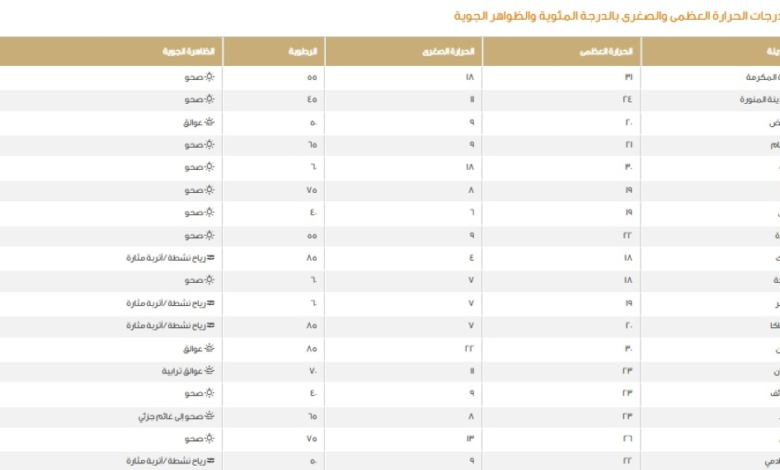
The latest reports issued by the National Center for Meteorology a significant decrease in minimum temperatures in a number of regions of the Kingdom of Saudi Arabia on Thursday/Friday night, with the city of Dammam and the capital Riyadh recording 9 degrees Celsius, indicating that relatively cold weather prevailed over the central and eastern regions during the night and early morning hours.
Climatic and geographical variations in the Kingdom
This report reflects the great climatic diversity that characterizes the Kingdom of Saudi Arabia, given its vast geographical area and varied topography. While the northern regions and highlands are experiencing a sharp drop in temperatures, reaching 4 degrees Celsius in Tabuk and As-Soudah, and 5 degrees in Tarif, the western and southwestern coastal areas maintain moderate and warm temperatures, with Jazan and Al-Qunfudhah recording 22 degrees Celsius, and Jeddah 18 degrees Celsius.
This variation in temperatures is a key feature of the Kingdom’s climate in winter and transitional periods, as the northern and central regions are affected by cold air masses coming from the north, while the Red Sea acts as a moderating factor in the coastal cities.
List of minimum temperatures recorded
The minimum temperatures in various cities and governorates were
- Eastern and Central Region: Dammam (9), Riyadh (9), Buraidah (9), Al Majmaah (9), Al Dawadmi (9), Al Kharj (10), Al Ahsa (12), Hafr Al Batin (8), As Samman (8), Ad Dahna Desert (9), Rawdat At Tanhat (9).
- Western and coastal region: Makkah (18), Madinah (11), Jeddah (18), Taif (9), Yanbu (13), Al Qunfudhah (22), Al Wajh (15).
- Northern regions: Tabuk (4), Hail (6), Arar (7), Sakaka (7), Al Qurayyat (7), Tarif (5), Rafha (9).
- Southern Region: Abha (8), Jazan (22), Najran (11), Al-Baha (7), Bisha (12), Al-Soudah (4), Sharurah (13), Wadi Al-Dawasir (13).
The importance of following weather reports
This data is of paramount importance to citizens and residents for organizing their daily lives, from choosing appropriate clothing to avoid catching a cold, to planning camping trips and outings that are common in such weather. This information is also vital to the agricultural sector, especially in areas where temperatures approach freezing, as farmers need to take preventative measures to protect crops from potential frost.
The National Center of Meteorology calls on everyone to follow the daily reports and early warnings to ensure public safety, especially with weather fluctuations that may witness activity in surface winds or a decrease in horizontal visibility in some open areas.