Lowest temperature in Saudi Arabia today: Sakaka records -5 degrees Celsius
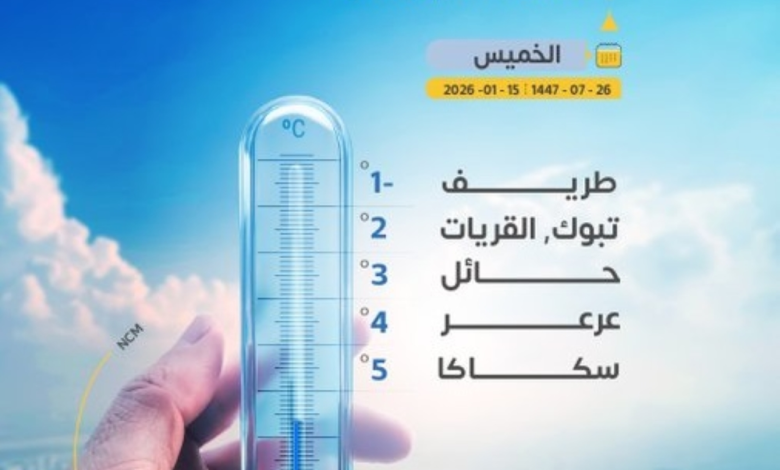
Several regions in Saudi Arabia experienced a sharp drop in temperatures early Thursday morning, with bitterly cold weather prevailing in the northern areas, recording sub-zero temperatures. The city of Sakaka topped the list, registering the lowest temperature in the Kingdom, according to the National Center for Meteorology.
List of the coldest cities today
Data from the National Center for Meteorology showed that the cold wave affected several cities, with the following minimum temperatures recorded:
- Sakaka: 5 degrees Celsius below zero (the coldest).
- Arar: 4 degrees Celsius below zero.
- Hail: 3 degrees Celsius below zero.
- Tabuk: Two degrees Celsius below zero.
- Al Qurayyat: Two degrees Celsius below zero.
- Tarif: One degree Celsius below zero.
The geographical and climatic context of the cold wave
These sharp drops in temperature are part of the typical climatic characteristics of the northern regions of the Kingdom during winter, specifically in January and February. Areas such as Al-Jawf, the Northern Borders, and Tabuk are affected by polar air masses originating from Siberia or Eastern Europe, making them prone to recording significantly lower temperatures compared to the rest of the Kingdom. Historically, these regions are known as the gateway to the Kingdom's cold, and they frequently experience frost and snowfall, especially in the mountainous areas.
Weather conditions and forecasts
These cold waves have a direct impact on daily life, requiring residents to take appropriate heating measures. They also directly affect the agricultural sector due to the potential for frost, which can damage winter crops. Regionally, this phenomenon often coincides with low-pressure systems affecting the Levant, which in turn reinforces the flow of cold winds towards northern Arabia.
In its weather report for Thursday, the National Center for Meteorology forecast continued cold to very cold weather across parts of Tabuk, Al-Jawf, the Northern Borders, Hail, Al-Qassim, Riyadh, and the Eastern Province. The report also warned of active surface winds stirring up dust and sand, reducing horizontal visibility, particularly in the southern parts of the Eastern Province and Riyadh, extending to Najran and parts of Makkah and Madinah.
Regarding rainfall, there is still a chance of scattered rain and partly cloudy skies over the highlands of Jazan, Asir, and Al-Baha, extending to parts of Makkah, Riyadh, and the Eastern Province, with warnings of dense fog formation during the night and early morning hours, which calls for caution and vigilance while driving on highways.