Saudi achievement: Manufacturing a nanomaterial for cartilage repair in space
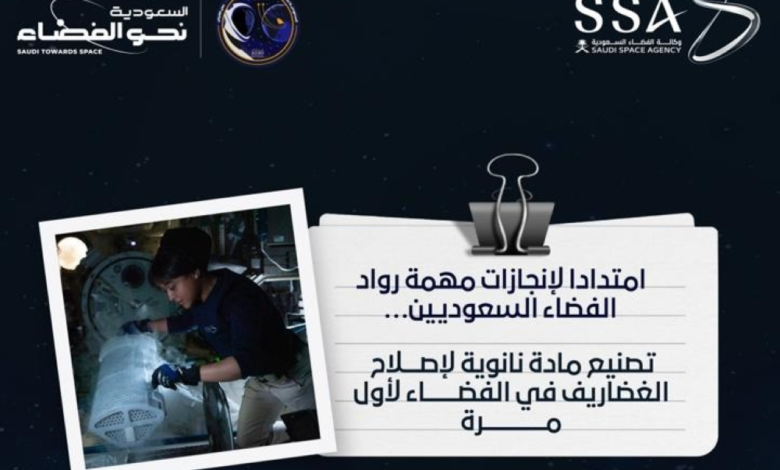
In a move reflecting the Kingdom of Saudi Arabia's rapid scientific progress on the international stage, the Saudi Space Agency a groundbreaking scientific achievement: the successful manufacturing of a nanomaterial designed for cartilage repair in the space environment. This announcement culminates the intensive research efforts that accompanied the Kingdom's historic space mission (SSA-HSF1), confirming the transformation of Saudi spaceflights from mere exploration to platforms for advanced scientific research serving humanity.
Details of the scientific achievement at the International Space Station
This discovery resulted from a high-level international scientific collaboration, with the research team led by Yubing Chen and Mary Ann Snow, while Saudi astronaut Rayana Barnawi the practical aspects of the experiment aboard the International Space Station. The experiment focused on developing advanced biomaterials for tissue engineering in a microgravity environment, an environment that provides unique conditions not found on Earth's surface, allowing cells and nanomaterials to form and grow in more precise and efficient ways.
Why manufacture in space?
This experiment is of paramount importance because it leverages the properties of outer space in pharmaceutical and medical manufacturing. On Earth, gravity negatively impacts tissue formation and leads to cell aggregation, hindering the production of high-quality, three-dimensional nanomaterials. In space, however, weightlessness allows for the formation of more ordered and refined nanostructures. The results, published in the prestigious journal *Nature*, demonstrated that the material manufactured in space significantly surpassed its counterparts produced in terrestrial laboratories in terms of precision and quality.
Medical importance and global impact
This achievement holds great promise for the field of regenerative medicine and the treatment of chronic injuries. Cartilage is one of the most difficult tissues in the human body to repair or regenerate itself due to its poor blood supply. Therefore, the successful synthesis of this nanomaterial opens new horizons for developing effective treatments for osteoarthritis, sports injuries, and age-related diseases, supporting the global trend toward the production of human tissues and advanced treatments that may reduce the need for traditional joint replacement surgeries in the future.
Vision 2030 and the Future of Innovation
The Saudi Space Agency affirmed that these scientific achievements are not a coincidence, but rather the result of strategic planning that reflects the integrated role of scientists and astronauts. These successes solidify the Kingdom's position as an active partner in the international space community and maximize the scientific benefits of manned missions, perfectly aligned with the goals of Vision 2030 , which seeks to build a knowledge-based and innovation-driven economy and harness technology to improve the quality of human life.