Jeddah Astronomy Society: The truth about the relationship between planetary alignment and earthquakes in 2026
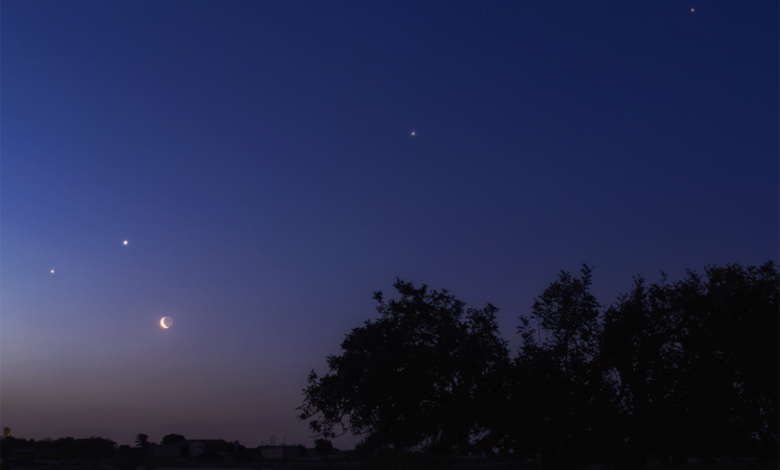
The Jeddah Astronomical Society has put an end to the recurring debate surrounding the alleged link between celestial movements and natural disasters, categorically denying the validity of rumors linking planetary alignments to devastating earthquakes. This came in a detailed scientific response to warnings recently circulating on social media platforms, which were based on unscientific claims made by the controversial Dutch researcher Frank Hoogbeets.
The reality of the five-way alignment in January 2026
Engineer Majed Abu Zahra, head of the Jeddah Astronomical Society, explained that the recent controversy revolves around an upcoming astronomical event between January 6 and 11, 2026, known as the "Pentacent alignment." This event involves the apparent alignment of the Sun and Earth with the planets Mars, Venus, and Jupiter. Abu Zahra emphasized that this alignment is purely optical, dependent on the observer's perspective from Earth, and does not mean that the planets are physically aligned in a straight line in space that would have any physical effect on Earth's crust.
He pointed out that these phenomena occur periodically and naturally in the mechanics of the solar system, and it has not been proven historically or scientifically that they are related to any increase in seismic or volcanic activity, which makes the warnings circulating mere unfounded fears.
The scientific basis: Why don't planets cause earthquakes?
In refuting these claims, the scientific explanation expands to clarify the vast difference between the forces causing earthquakes and planetary gravitational forces. Earthquakes are the product of purely internal geological processes, resulting from the movement of tectonic plates and the accumulation of stress in the Earth's crust over years or decades, with this energy being suddenly released through fault lines.
According to the laws of physics, the gravitational influence of planets—even giant ones like Jupiter—on Earth is extremely small, almost negligible, compared to the influence of the Moon and the Sun, due to the vast distances separating us from them. Even the Moon, the closest celestial body and a direct influence on ocean tides, does not possess enough force to move solid rock or cause earthquakes.
Historical background and the impact of rumors
These clarifications come at a time of increasing misinformation, with some, like the Dutchman Hoogbeets, linking planetary engineering to earthquakes—an approach rejected by the global scientific community, including the U.S. Geological Survey and major earthquake monitoring centers. Experts warn that promoting such theories leads to unwarranted panic and distracts from genuine safety measures and scientifically based preparedness for natural disasters.
An invitation to enjoy the astronomical phenomenon
The head of the Jeddah Astronomical Society concluded his remarks by emphasizing that the planetary alignment in 2026 should be viewed as a beautiful celestial event, an opportunity for astronomy and photography enthusiasts to observe the planets as they appear close together, rather than as a source of fear. He stressed the importance of obtaining information from official and reliable scientific sources and not being swayed by interpretations lacking scientific evidence. He affirmed that modern science is still unable to accurately predict the timing of earthquakes, and that linking them to the planets is a form of astrology, not science.