Saudi Arabia's roads: Coordinating camel crossings via 938 for the safety of travelers
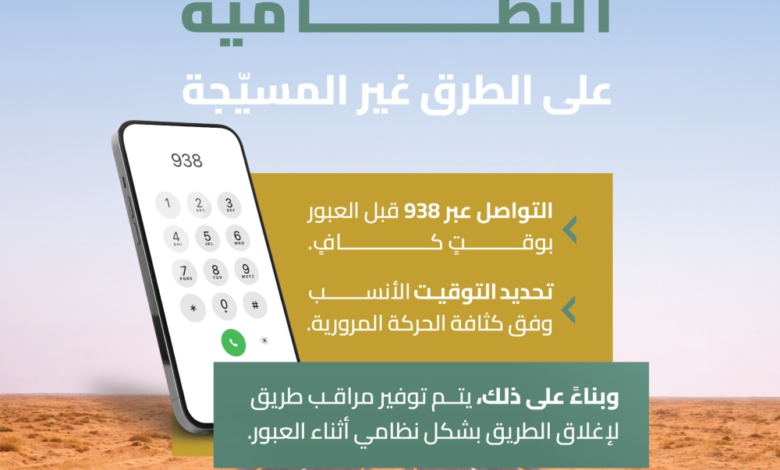
The General Authority for Roads in Saudi Arabia has called on all camel owners wishing to transport their camels across roads lacking protective fencing or designated camel crossings to contact the unified call center (938) in advance. This measure aims to coordinate safe and organized crossings within the road network, ensuring that all necessary precautions are taken to protect lives and property and enhance traffic safety standards.
Precautionary measures to ensure safe passage
The authority explained that it has put in place detailed precautionary plans to regulate camel crossings on single-lane roads or those that have not yet been fenced. The approved mechanism involves owners coordinating with the call center to determine the most suitable time for crossing, stipulating that the transfer must be carried out in one group and exclusively during daylight hours to ensure clear visibility. The process also requires the presence of the designated road supervisor, who is responsible for securing the route and placing warning cones and signs to alert drivers before they reach the crossing area.
The context of traffic safety and the importance of regulation
These directives come as part of ongoing efforts to reduce traffic accidents caused by stray camels, which have long posed a significant challenge to the safety of motorists using the Kingdom's highways and desert roads. While camels are an integral part of Saudi Arabia's cultural and economic heritage, their uncontrolled movement near highways can lead to catastrophic accidents. Therefore, this regulation is a crucial step towards balancing the need to facilitate the movement of herders and camel owners with maintaining the highest levels of safety for road users, reflecting the integrated efforts of government agencies and the community.
Infrastructure and camel crossings
As part of its efforts to enhance infrastructure, the Authority noted that the Kingdom's road network now includes more than 50 camel crossings, in addition to the fencing of over 3,056 kilometers of roads. These projects were implemented as regulatory and security measures aimed at increasing safety levels and preventing animals from unexpectedly entering roadways. The Authority emphasized that the design of these fences and crossings was based on meticulous engineering studies to minimize collision risks, while also warning that deliberately cutting the fence is a legal violation that will subject the perpetrator to prosecution, given the direct threat it poses to lives.
Strategic targets for the roads sector
It is worth noting that the General Authority for Roads continues to implement a package of vital projects and initiatives that contribute to achieving the objectives of the roads sector strategy stemming from the Kingdom's Vision 2030. The Authority aims to elevate the Kingdom to sixth place globally in the road quality index and reduce the traffic fatality rate to less than 5 deaths per 100,000 people. It also works to ensure the road network meets traffic safety standards according to the International Road Assessment Programme (IRAP) classification, while maintaining a high level of service that meets the network's increasing capacity and enhances the efficiency of transportation between the Kingdom's far-flung regions.