The conjunction of the Moon and the Pleiades in Ramadan 2026: A guide to observation and viewing
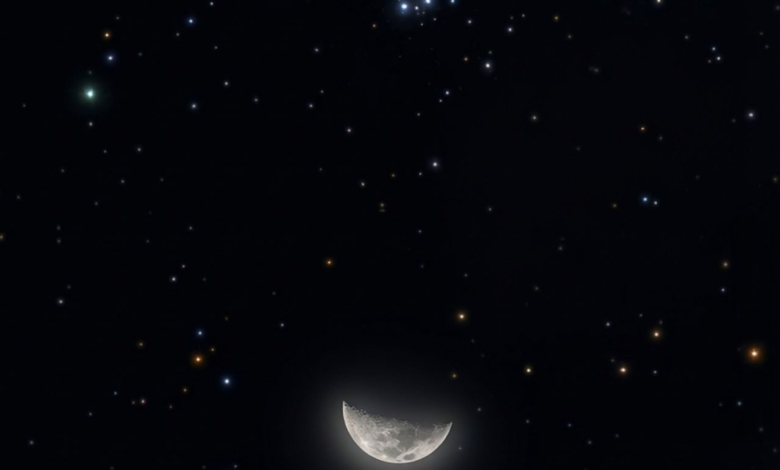
The Jeddah Astronomical Society announced an anticipated astronomical phenomenon that will grace the skies of the Arab world. Observers are expected to witness a beautiful celestial conjunction between the crescent moon of Ramadan and the famous Pleiades star cluster on the evening of Monday, February 23, 2026. The Society's president, Engineer Majid Abu Zahra, explained that this event presents an exceptional opportunity for astronomy enthusiasts, photographers, and the general public to enjoy the beauty of the celestial sphere.
What is the conjunction of the Moon and the Pleiades?
The waxing crescent moon will appear close to the Pleiades star cluster, also known as the Seven Sisters, in a celestial display visible to the naked eye just after sunset and as darkness falls. This apparent proximity of the two celestial bodies offers observers a unique opportunity to contemplate the beauty of the winter sky, with its bright and clear stars.
The Pleiades Cluster: History and Cultural Significance
The Pleiades star cluster holds a special place in both astronomy and human heritage. It is an open star cluster located approximately 440 light-years from Earth, comprising hundreds of young stars born from the same cloud of cosmic gas and dust. Despite its vast number of stars, only seven are the brightest and can be distinguished with the naked eye under ideal conditions, earning it the name "Seven Sisters" in Greek mythology. In Arab tradition, the Pleiades also held a prominent place, its appearance linked to agricultural seasons and weather changes, and it was mentioned in ancient poetry and proverbs as a harbinger of the beginning of winter and the cold season.
The scientific and aesthetic importance of the event
From a scientific perspective, conjunctions are visual events resulting from the alignment of celestial bodies along a single line of sight from Earth. There is no actual convergence in the vast expanse of space between the Moon, our nearest neighbor, and the Pleiades star cluster, which lies at great distances from us. However, the importance of these phenomena lies in their practical application of our understanding of the movement of celestial bodies and their precise orbits. They also serve as an effective educational tool for making astronomy accessible to the public. Aesthetically, the convergence of the moon's tranquil light with the distinctive blue glow of the young Pleiades stars creates a natural masterpiece that inspires photographers and offers viewers moments of peace and tranquility away from the hustle and bustle of daily life, especially as it coincides with the spiritual atmosphere of the holy month of Ramadan.
Tips for monitoring and photography
Abu Zahra advised those wishing to view the phenomenon that the moon's brightness might obscure the relatively faint Pleiades stars. Therefore, using binoculars or a small telescope will reveal more vivid details of the star cluster and make it appear more clearly near the moon. For astrophotography enthusiasts, this conjunction presents an ideal opportunity to capture stunning images using long-exposure techniques, which can reveal the faint blue nebulae and cosmic dust surrounding the Pleiades stars—the remnants of the cloud from which these stars formed.
Abu Zahra emphasized that the best viewing locations are far from city lights and light pollution, where the sky is clearer and darker, allowing for a clearer view of the celestial scene. While circulating images may exaggerate the cluster's appearance, viewing it with the naked eye or through binoculars remains a unique experience that connects us to the grandeur of the universe.