Observing the first quarter of the Ramadan moon in Arar: an important astronomical phenomenon
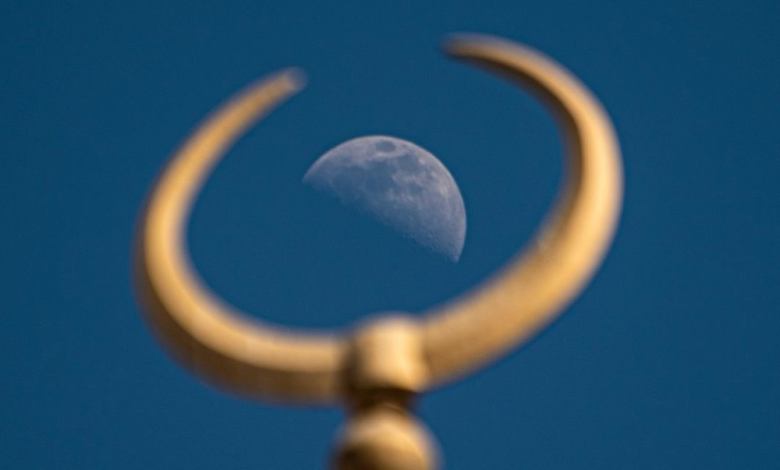
On Tuesday, the sky over the city of Arar in the Northern Borders region witnessed a distinctive astronomical phenomenon, which was the observation of the first quarter phase of the crescent moon of the holy month of Ramadan for the year 1447 AH. This is a celestial scene that embodies one of the main phases in the monthly cycle of the moon around the Earth, and it receives great attention from astronomers and amateurs alike.
What is the first quarter phase of the moon?
Astronomer and Astronomy Club member Adnan Khalifa explained that the Ramadan moon reached its first quarter phase at 3:28 PM. Scientifically, this phase occurs when the moon completes a quarter of its orbit around the Earth since the new crescent. At this point, the angle between the sun, moon, and Earth is almost perpendicular (90 degrees), meaning that half of the moon's disk facing us is fully illuminated by sunlight, while the other half is in darkness. This phase, along with the last quarter, is considered one of the best times to observe the lunar surface features, as the angle of the sunlight highlights the craters, mountains, and valleys with long, distinct shadows along the terminator, the line separating day and night on the moon's surface.
The historical and cultural significance of the phases of the moon
Throughout history, human life has been closely linked to observing the phases of the moon. Before the invention of modern clocks and calendars, the lunar cycle was the primary reference for determining time, regulating agricultural seasons, and organizing religious celebrations. In Islamic culture, observing the moon holds particular significance, as the Islamic calendar (Hijri calendar) is entirely based on its cycle. The beginning of each Islamic month, including Ramadan and the two Eid festivals (Eid al-Fitr and Eid al-Adha), is determined by the sighting of the new crescent moon. While the first quarter phase does not mark the beginning of the month, it represents a significant milestone on the halfway point towards the full moon, a phase that our ancestors used to track the passage of days and nights.
Arar as an ideal destination for astronomical observation
This observation comes amidst growing interest in astronomical phenomena in Saudi Arabia, particularly in the Northern Borders region, which boasts an ideal desert environment for such observations. The clear skies of Arar, relatively far from the heavy light pollution found in major cities, provide excellent conditions for amateur astronomers and photographers to capture stunning images of celestial bodies. This spectacle is not only a scientific event but also an invitation to contemplate the grandeur of the universe, enhancing the region's potential as a hub for astrotourism, where visitors can enjoy the beauty of the night sky and witness cosmic phenomena with unparalleled clarity.