The Crown Prince's project renovates the Al-Aqsa Mosque: reviving the legacy of the founding king
Reviving a historical landmark in the heart of Riyadh
The Prince Mohammed bin Salman Project for the Development of Historical Mosques places great importance on the Kingdom's architectural and religious heritage. A prime example of this is the inclusion of the Al-Qibli Mosque in the old town of Manfouha in Riyadh among the mosques covered by the project. This mosque is not merely a place of worship; it is a historical record that recounts chapters of the modern Saudi state's history. It was built during the reign of the founding King Abdulaziz bin Abdul Rahman Al Saud – may God have mercy on him – to serve as a religious beacon and a social center for the people of the region.
Historical background and cultural significance
The town of Manfouha, now part of the urban expansion of Riyadh, lies on the banks of Wadi Hanifa and boasts a rich history dating back to pre-Islamic times. Within this historical context, King Abdulaziz ordered the construction of the Qibli Mosque around 1364 AH (1945 CE), and its construction was undertaken by the builder Abdullah bin Masoud. The mosque acquired its name, "Qibli," due to its location west of Manfouha and its proximity to the Emir's palace on the southeastern side. This made it the closest mosque to the seat of government in the town, where princes and high-ranking officials would pray, thus granting it significant symbolic and administrative importance over the decades.
An architectural masterpiece in the Najdi style
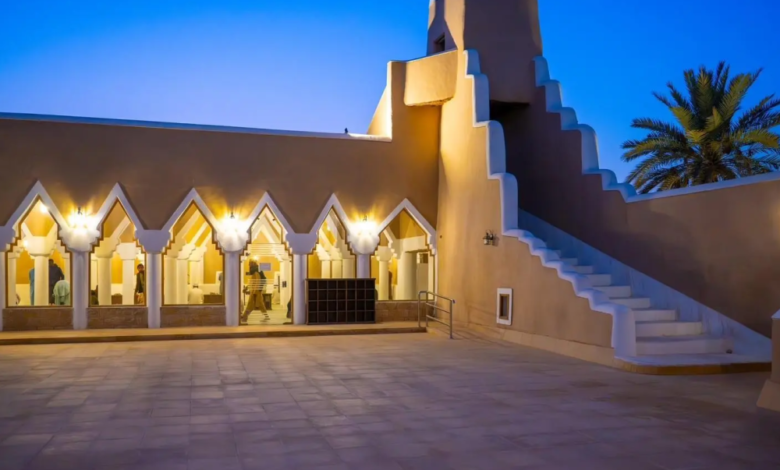
The Qibli Mosque is a prime example of traditional Najdi architecture, relying on local materials. Constructed using mud bricks and adobe, and roofed with tamarisk tree trunks and palm fronds, it employs environmentally friendly building techniques adapted to the desert climate. Spanning approximately 500 square meters, the mosque comprises an inner prayer hall, an open outer courtyard, and a lower alcove used for prayer during the harsh winter months. The mosque's roof rests on 33 stone columns, and its square minaret stands at the center of the northern side of the building. The current restoration project aims to preserve this unique architectural identity, utilizing the same traditional materials and methods to ensure the building's authenticity and sustainability.
Project objectives and future impact
The Prince Mohammed bin Salman Project for the Development of Historical Mosques aims to strike a delicate balance between preserving the authentic heritage character of mosques and equipping them to meet the needs of worshippers in the modern era. Restoration work is not limited to structural repairs; it also includes the rehabilitation of these mosques to restore their vital role as centers of worship, education, and community guidance. The revitalization of the Qibli Mosque and other historical mosques is an integral part of the Kingdom's Vision 2030, which focuses on highlighting the Kingdom's cultural and civilizational heritage and strengthening national identity. This project is expected to transform these landmarks into cultural and religious destinations that attract visitors and researchers, and solidify their historical value in the memory of future generations.