King Abdulaziz University students win award for reviving Indian factories
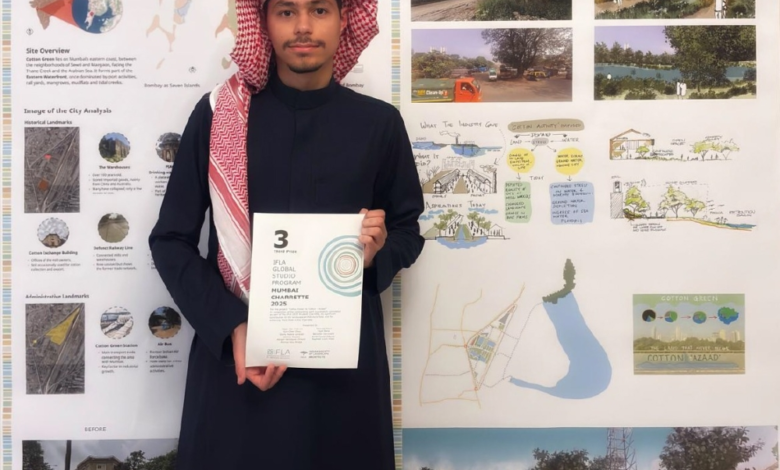
In an international achievement showcasing the talents of young Saudis on the global stage, a student team from the Department of Environmental Architecture at the Faculty of Architecture and Planning at King Abdulaziz University in Jeddah secured third place in a prestigious international competition held in Mumbai, India. This victory is a culmination of the efforts of student Ammar Hatem Abu Al-Naja and his team, who presented an innovative architectural vision for the revitalization of industrial heritage sites in India, specifically historic cotton mills.
Historical background: Cotton mills in Mumbai
Mumbai, once known as the “Manchester of the East,” boasts a rich industrial history, heavily reliant on textiles and cotton. Since the 19th century, vast cotton mills formed the backbone of the city’s economy, providing employment for millions. However, with global economic shifts and the decline of traditional industries in the late 20th century, most of these mills closed, becoming abandoned structures and dilapidated areas in the heart of one of the world’s most densely populated cities. These mills have left behind an urban void and significant environmental and social challenges, making them ideal subjects for urban regeneration projects seeking to revitalize these once-thriving industrial arteries.
The “Cotton Green to Cotton Azaad” project: A sustainable Saudi vision
The winning project, submitted by the King Abdulaziz University team, was titled “Cotton Green to Cotton Azaad.” Its aim was to transform the “Cotton Green” area from a neglected industrial zone into a vibrant heritage and cultural space. The project distinguished itself by offering sustainable and comprehensive solutions that address the complex challenges facing the area, such as seasonal flooding, deteriorating industrial structures, and the disconnect between the urban fabric and the local community.
The proposed strategies included creating rainwater harvesting basins to mitigate flooding, restoring coastal mangrove forests to enhance biodiversity and protect beaches, and repurposing historic industrial buildings into cultural and community centers and open green spaces. The design also focused on creating pedestrian and bicycle paths to foster urban connectivity and encourage social interaction, achieving a unique balance between preserving the historical memory of the place and meeting the demands of modern life.
The importance and expected impact of the achievement
This victory is not merely an academic achievement; it carries broader implications. Locally in Mumbai, the project offers a practical model that can be applied to rehabilitate dozens of abandoned industrial sites, contributing to the provision of much-needed public spaces and improving the quality of life for residents. Internationally, this achievement highlights the ability of young Saudi minds to compete globally and offer innovative solutions to global urban challenges, aligning with the goals of Saudi Vision 2030 to build a knowledge-based and innovation-driven economy and promote cultural and academic exchange. The competition, which included students from 27 universities worldwide, was held under the auspices of the International Federation of Environmental Architects (IFLA) and the Indian Society of Environmental Architects (ISOLA), and under the direct supervision of Dr. Amer Mohammed Habibullah from King Abdulaziz University, further adding to the department's record of successes on the international stage.