Venus at apogee 2026: Details of an unseen astronomical event
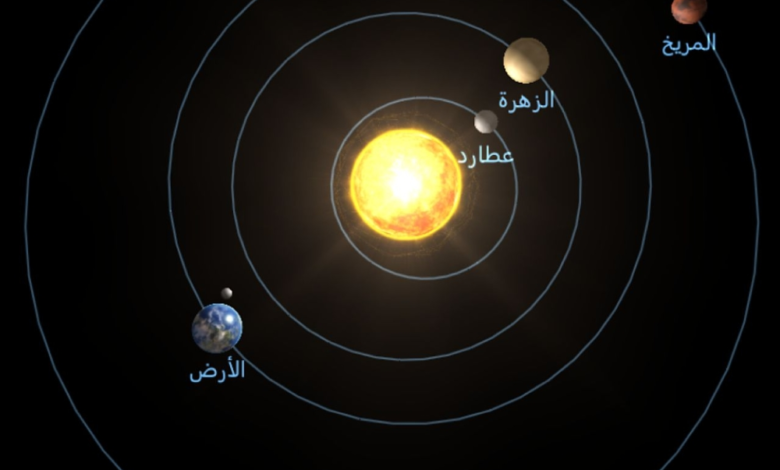
The Jeddah Astronomical Society, through its president, Engineer Majid Abu Zahra, announced that the Earth's skies will witness a significant astronomical event on Thursday, January 22, 2026, involving Earth's neighbor, Venus. The planet will reach its aphelion, the point in its orbit farthest from the Sun, a phenomenon that occurs periodically and highlights the precision of the solar system's mechanical system.
Details of the solar apogee phenomenon
Engineer Abu Zahra explained that Venus, despite being the second planet from the Sun after Mercury, orbits in a nearly perfectly circular path, making it the planet with the least eccentric orbit in the solar system. However, this orbit is not a perfect circle, meaning there are two key points in its path: perihelion (closest to the Sun) and aphelion (farthest from the Sun). At this event, the distance between Venus and the Sun will be approximately 109 million kilometers.
Why is it impossible to detect the event?
Despite the astronomical significance of this event, the head of the Jeddah Astronomical Society confirmed that it will not be visible to observers on Earth, either with the naked eye or even using telescopes and binoculars. The scientific reason for this is the planet's apparent position relative to the sun; Venus will be very close to the sun's disk in the sky (the angular elongation is small), making it almost completely obscured by the sun's bright glare.
Abu Zahra warned against attempting to search for or observe the planet at this time, as pointing any optical instrument towards the area surrounding the sun poses a serious risk to the retina that could lead to permanent vision loss.
Scientific context and importance of the event
This phenomenon is more important from a mathematical and physical perspective than from an aesthetic, observational one. By precisely determining the timing of planets reaching their aphelion and perihelion points, astronomers can:
- Testing the accuracy of Kepler's laws of planetary motion and the laws of universal gravitation.
- Updating orbital data used in launching spacecraft and interplanetary probes.
- Adjusting the astronomical calendars and celestial maps that researchers around the world rely on.
Venus, nicknamed "Earth's twin" due to their similar size and mass, is a fertile field for astronomical studies. Despite its similarity to Earth in rocky composition, it possesses a very dense atmosphere that causes a powerful greenhouse effect, making it the hottest planet in the solar system. Studying its orbit is part of our overall understanding of the evolution of rocky planets.
The Jeddah Astronomical Society concluded its statement by emphasizing that the regularity of these astronomical events reflects the greatness of the cosmic order and the physical precision that governs the movement of celestial bodies in the vastness of space.