The truth about planetary gatherings: a safe and recurring astronomical phenomenon
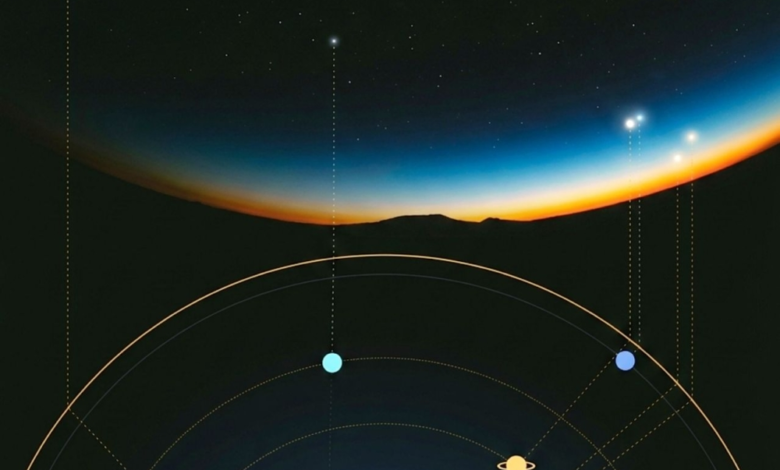
The Jeddah Astronomical Society issued a statement clarifying the widespread posts on social media platforms regarding what was described as a “rare planetary alignment” expected to occur on February 28, 2026. The Society confirmed that these sensational descriptions, which claim that the alignment is exceptional and may not be repeated for centuries, lack scientific accuracy, explaining that what will happen is an apparent angular convergence of a number of planets in the solar system in one direction of the sky as viewed from Earth, which is a natural and recurring phenomenon.
To understand this phenomenon, it's important to know that all the planets in our solar system revolve around the Sun in roughly the same orbital plane known as the ecliptic. Because of their varying speeds and orbits, their positions are constantly changing relative to each other and to us on Earth. When several planets happen to pass through the same part of their orbits, they appear close together in a narrow band across the sky. This apparent closeness is merely an optical illusion based on our perspective; the actual distances between these planets in outer space remain enormous, estimated at hundreds of millions of kilometers.
Historically, planetary alignments held great interest for ancient civilizations who meticulously observed the heavens. In ancient astrology, these alignments were believed to have significant influences on human destinies and events on Earth. However, modern science, based on physics and mathematics, has definitively proven that these phenomena are merely celestial mechanical events that can be predicted with great accuracy and have no tangible physical effect on our planet. The combined gravitational force of these planets is extremely small and cannot be compared to the gravitational force of the Sun or even the Moon, which directly influences the tides.
In detailing the anticipated event, the head of the association, Engineer Majed Abu Zahra, explained that most of the planets mentioned in the circulated publications will not be easily visible. Mercury and Saturn will be very close to the sun's glare after sunset, making them nearly impossible to observe with the naked eye. Uranus and Neptune are extremely faint and require a telescope to see. Therefore, the only two planets that might be relatively clear in the evening sky are Venus and Jupiter. Abu Zahra emphasized that talk of seeing a "clear chain of planets" or their alignment in a "straight line" is scientifically inaccurate and exaggerated.
Abu Zahra emphasized that this optical phenomenon has no known or anticipated physical effects on Earth. He categorically denied any proven scientific link between planetary alignments and earthquakes, volcanic eruptions, or climate change, describing such claims as misinformation unrelated to astronomy. He added that phrases like "it won't happen again" are often used for sensationalist purposes, while scientific reality indicates that apparent planetary alignments occur to varying degrees every few years.
He concluded by emphasizing that this phenomenon, far from being sensationalized, represents a significant educational opportunity for amateur astronomers and those interested in understanding the geometric structure of the solar system. It allows observers to track the movement of the planets and visualize their various orbits, thus enhancing our understanding of our place in this vast universe. It is an invitation to look at the sky with the eye of science and appreciation, not with the eye of fear or superstition.