Death toll from landslide in Indonesia rises to 50 in West Java
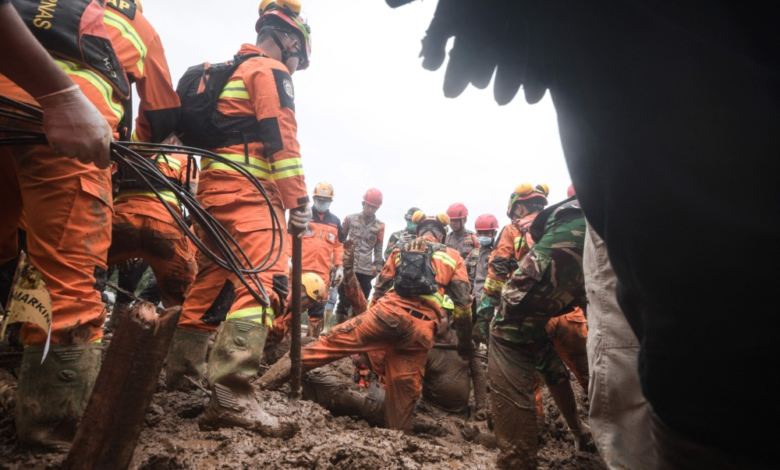
Indonesian authorities announced today that the death toll from the devastating landslide that struck West Java province last weekend has risen to 50, while rescue teams are still racing against time to find 33 others still missing under the rubble.
Details of the disaster and efforts to identify the victims
Indonesian police in the province reported that the Disaster Victim Identification Team (DVI) has officially received 50 bodies recovered from the landslide site in West Bandung. This announcement followed extensive and complex search operations conducted by joint search and rescue teams. Medical reports indicate that 34 victims have been identified so far, facilitating the release of the bodies to their families for burial.
In a painful detail about the victims, the Indonesian Navy confirmed that among those whose deaths were confirmed were four members of the naval forces, who perished after huge quantities of mud and debris suddenly swept through the residential village, following the collapse of the adjacent hill in the early morning hours of last Saturday.
Challenges facing rescue teams
Search and rescue operations face enormous logistical and environmental challenges. Indonesian authorities explained that the efforts, involving military and police forces supported by civilian volunteers, have encountered extremely dangerous field conditions. The soil remains unstable, and intermittent rainfall increases the risk of further landslides, forcing field teams on several occasions to temporarily halt operations to ensure the safety of rescuers before cautiously resuming them.
Indonesia: The Geography of Natural Disasters
This incident once again highlights the challenging geographical reality of Indonesia. The Indonesian archipelago is one of the most disaster-prone areas in the world, due to its location within the Pacific Ring of Fire, a region characterized by intense seismic and volcanic activity. These risks are typically exacerbated during the monsoon season, when the soil becomes saturated with water, leading to deadly landslides, particularly in mountainous and rugged areas like the island of Java.
Environmental and human impacts
Landslides are a recurring phenomenon in Indonesia, but their severity has increased in recent years. Environmental experts link the frequency of these disasters to human factors such as deforestation and unplanned urban expansion on sloping areas, which weakens soil stability. These disasters result in significant loss of life and the displacement of thousands annually, placing considerable pressure on the Indonesian government to strengthen safety measures and develop early warning systems in the most vulnerable areas.