Air traffic in Greece was halted due to a sudden radio malfunction
Air traffic in Greece was severely disrupted and temporarily paralyzed on Sunday after the Greek Civil Aviation Authority announced the cancellation and delay of a large number of flights at several major airports. This disruption was caused by a technical fault described by authorities as "unprecedented," consisting of a sudden interruption of radio frequencies in the airspace, resulting in a loss of vital communication between air traffic control towers and aircraft.
Details of the crisis at Athens airport
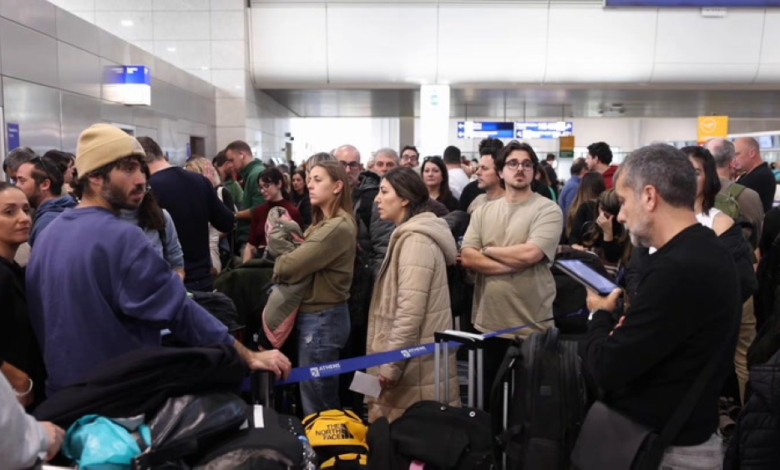
The crisis was centered primarily at Eleftherios Venizelos International Airport in Athens, the country's main gateway. Reports indicated thousands of passengers queuing in long, tense lines due to the suspension of both domestic and international flights. According to data released by the airport's press office, which handled approximately 31.6 million passengers in the first 11 months of 2025, the runways were completely empty of takeoffs and landings for over two hours, starting at 7:00 AM GMT, a peak morning time that typically sees heavy air traffic.
Diverting the route to Türkiye and gradually returning
As a precautionary measure to ensure the safety of passengers and aircraft in the airspace, air traffic control authorities were forced to divert most flights bound for Greek airports to Turkish airspace and nearby Turkish airports. This measure lasted for up to three hours, according to Greek state broadcaster ERT, reflecting the scale of the logistical challenge faced by air traffic management in the region. Normal operations only began to gradually return to normal around 11:00 GMT.
dilapidated infrastructure and union warnings
The incident sparked a wave of sharp criticism regarding the readiness of air navigation infrastructure in Greece. In a notable statement, Panagiotis Psaros, head of the Greek air traffic controllers' union, described the incident as "very serious," directly attributing it to the outdated equipment and devices used at the airport, stating that they were "obsolete" and no longer met the modern standards required to manage current air traffic volumes.
The economic context and the importance of air safety
This incident is particularly significant given the Greek economy's heavy reliance on tourism, with air transport serving as the primary artery for visitors to Greek islands and cities. The recurrence of such technical malfunctions could negatively impact Greece's reputation as a safe and reliable tourist destination, especially in the face of intense regional competition. Furthermore, radio silence is one of the most dangerous scenarios in aviation, as airspace safety depends entirely on the immediate guidance of air traffic controllers to manage flight paths and prevent collisions. This makes upgrading these systems a top priority for national security and public safety.