Farmers' protests in France defy government calls for a truce
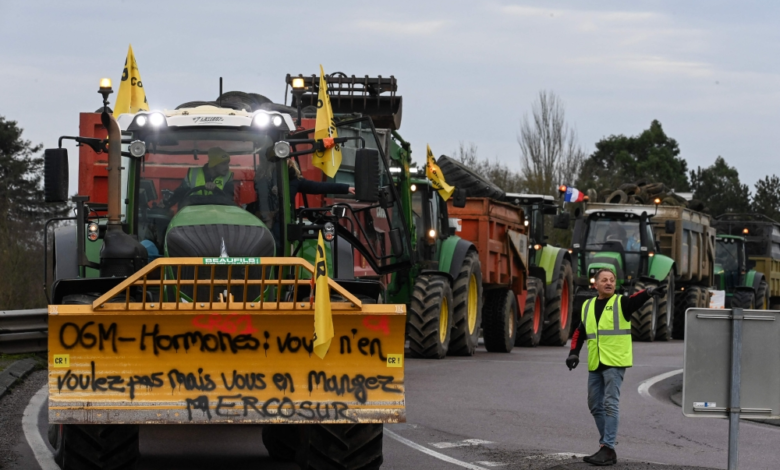
On Saturday, French farmers continued their protest actions by blocking major roads in southwestern France, expressing their categorical rejection of the way authorities are handling the health crises hitting the livestock sector, in a clear challenge to the French government's calls to observe a "truce" during the Christmas period.
Details of the field closure
Traffic was paralyzed on several key routes as the left-leaning farmers' union, Confédération Paysanne, erected new roadblocks. This escalation led to the closure of the A75 motorway between Clermont-Ferrand and Montpellier in the southbound direction for several hours before it was later reopened.
In a more complex situation, the A64 motorway, linking Toulouse and Bayonne, remained closed for over 180 kilometers, causing significant traffic disruptions. The vital A63 highway, connecting Bordeaux to the Spanish border near Sestas, was also closed, threatening overland trade between France and Spain.
Health policies and the roots of the crisis
These protests are a direct reaction to the government's health policies for combating outbreaks of infectious diseases among livestock, specifically contagious lumpy skin disease. In this context, Sarah Melki, spokesperson for the farmers' union in the Aveyron region, told AFP: "As long as there is no change in health policy, and as long as the government continues with the systematic and complete culling of any disease outbreak on a farm, we will continue to mobilize." This statement reflects the deep divide between farmers, who see the mass culling as devastating to their livelihoods, and the government's strict measures.
General context and accumulated challenges
These protests cannot be separated from the broader context of the agricultural sector in France and Europe as a whole. French farmers have long been struggling with increasing pressures related to rising production costs, stringent European environmental standards, and foreign competition. The current health crisis has proven to be the final straw, with protesters demanding alternatives to the complete culling of livestock, such as enhanced vaccination programs and fair compensation.
Economic and logistical impacts
The timing of these protests is highly significant, coinciding with the peak holiday season for family and tourist travel. The closure of strategic routes, such as the one leading to Spain, not only disrupts travel but also cripples logistical supply chains at a critical time of year. According to the Ministry of the Interior, 50 protests involving 1,619 people were recorded on Saturday, a slight decrease compared to the 93 protests and nearly 4,000 participants on Friday. However, the continued closure of major roads leaves the crisis open to all possibilities.