Chinese scientists measure the mass of a floating planet similar to Saturn for the first time
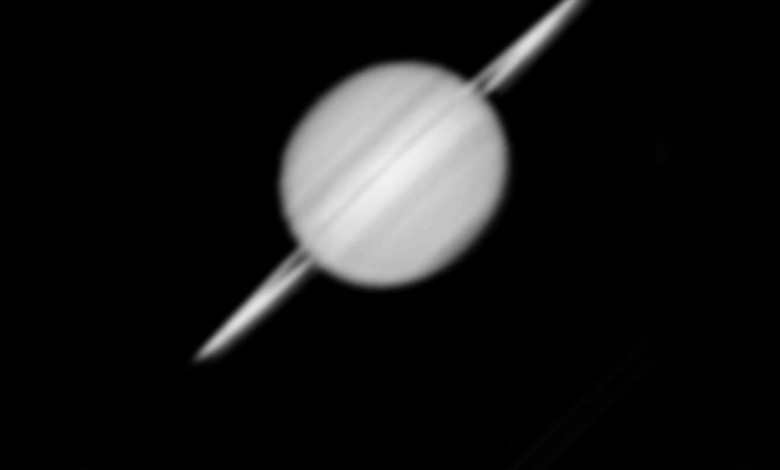
In a scientific first for astronomy, a team of Chinese scientists has achieved a remarkable feat by precisely measuring the mass of a rogue planet, confirming that it possesses a mass comparable to that of Saturn. This discovery, published in the prestigious journal Science, opens new avenues for understanding the nature of celestial bodies that roam space independently, without orbiting a host star.
What are floating planets?
To understand the significance of this event, we must delve into the scientific background of these objects. Rogue planets, also known as "frog planets," are celestial bodies that have broken away from their parent star systems or formed independently, floating in interstellar space in complete isolation. Although nearly ten such objects have been discovered in the past decade using ground-based telescopes, determining their physical properties, particularly their mass, has remained a significant challenge for scientists due to the absence of a nearby luminous star that could serve as a reference point for traditional measurements.
Gravitational microscope lens technology
The research team leader, Dong-Su Poh, from the Department of Astronomy at Peking University's School of Physics, explained that the team relied on a physical phenomenon predicted by Einstein's theory of relativity known as "microlensing." This phenomenon occurs when a floating object (the lens) passes in front of a distant star (the source), where the object's gravity bends and temporarily amplifies the background starlight, revealing the presence of the hidden object.
In 2024, scientists observed a microlensing event, but what was new in this research was the use of simultaneous double-observation techniques. By combining data from ground-based telescopes with data from a distant spacecraft, scientists were able to observe the event from two different angles (the parallax effect), allowing them to overcome the mass-distance decay and calculate the object's distance and mass separately and accurately, revealing it to be a planet with a mass similar to Saturn.
The importance of discovery and the future of space exploration
The significance of this achievement extends far beyond simply measuring a planet's mass; it serves as a pivotal reference point for future space missions. Reviewers in the journal Science noted that this research highlights the immense power of coordinated observations between Earth and space. These findings provide a roadmap for upcoming mega-projects, such as NASA's Nancy Grace Roman Space Telescope, which aims to discover thousands of these floating planets. This will help humanity understand how solar systems form and evolve, and perhaps answer questions about the prevalence of these rogue planets in our Milky Way galaxy.