China continues Taiwan drills for the second day, and Beijing vows a firm response
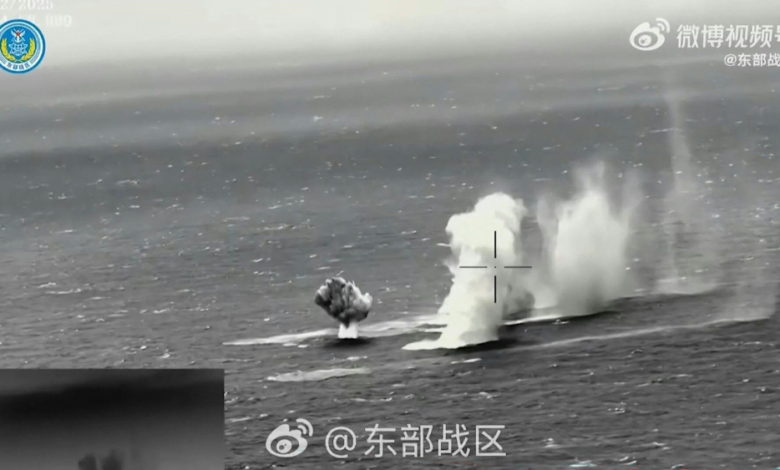
Tensions in the Taiwan Strait have entered a new phase of escalation, with Chinese Foreign Minister Wang Yi asserting on Tuesday that Beijing is determined to "firmly counter" what he called provocations. This comes as the Chinese military began its second day of live-fire exercises around Taiwan. This direct military action is seen as an angry response from Beijing to US arms sales to Taiwan, raising regional and international concerns about the stability of the Pacific region.
The context of tension and the challenges of globalization
In a speech delivered in Beijing, Wang Yi linked military tensions to the global economic situation, noting that economic globalization had faced a "severe test" this year. He explained that trade wars had disrupted the international trading system, emphasizing that China remains a "pillar of stability" in a world facing chaos that threatens global peace. These remarks take on particular significance given the historical context of the conflict, with China considering Taiwan an integral part of its territory, while the United States seeks to maintain strategic balance in the region by providing military support to Taipei without formally recognizing its independence.
US-China relations: between escalation and de-escalation
Relations between Washington and Beijing have been marked by sharp fluctuations this year, with US President Donald Trump previously announcing tariffs of up to 100% on Chinese goods, which Beijing retaliated with similar measures. However, tensions eased somewhat after the summit between Trump and Chinese President Xi Jinping last October in South Korea, which resulted in a one-year trade truce agreement. In this context, Wang Yi emphasized at an annual international relations conference that "cooperation between China and the United States benefits both countries, while confrontation harms both," warning Washington against crossing red lines concerning China's national interests.
The arms deal and the siege simulation
The spark that ignited the current round of escalation was Taiwan's mid-December announcement of a massive $11.1 billion arms deal with the United States. This announcement angered Beijing, which responded with a large-scale military deployment. Wang Yi stated, "In response to the continued provocations by pro-independence forces in Taiwan and the US arms sales, we must, of course, firmly oppose and resolutely counter them." These remarks came shortly after the Chinese military announced live-fire drills in waters north of Taiwan.
Taiwan: Drills "failed" and no blockade occurred
On the other hand, Taiwan downplayed the effectiveness of the Chinese moves. Taiwan's Ministry of National Defense asserted that the drills simulating a blockade of the island had "failed," despite Beijing's deployment of dozens of aircraft and warships. Hsieh Jie-shing, a senior official in Taiwan's military intelligence, stated, "Regarding their intention to impose a blockade, I think our coast guard has already made it clear that this blockade did not actually take place.".
For his part, Taiwanese President Lai Ching-te strongly condemned China's actions, stating in a post that China "disregards the international community's aspirations for peace and deliberately undermines regional stability through military intimidation," describing the situation as "a blatant provocation of regional security and the international order." The international community is watching these developments with concern, given the strategic importance of the Taiwan Strait as a vital artery for global trade, where any miscalculation could have far-reaching consequences.